 Chinese
 Italian
 Spain
Spain French
 German
 Arabic
 Portugese
Fatty Acid Amide Market Insights: Growth Trends, Applications, and Future Opportunities for Polymer Additives
Understanding the evolving landscape of fatty acid amides is essential for manufacturers and formulators seeking to optimize performance across modern polymer materials. As industries such as plastics, automotive, and packaging continue to advance, the role of polymer additives has shifted significantly, from basic processing aids to critical performance enhancers. This transformation is driving both market growth and technological innovation, making fatty acid amides one of the most important segments within oleochemical additives today.
Market Size and Forecast: A Dual Growth Perspective
A closer look at the market reveals two interconnected segments: the broader fatty amides market and the more specialized fatty amide lubricants segment. While both are expanding, the latter is experiencing faster growth due to its direct link to plastics and rubber processing.
Recent data indicates that the global fatty amides market was valued at approximately USD 430.1 million in 2024 and is projected to reach USD 558.2 million by 2030, reflecting a compound annual growth rate (CAGR) of 4.4%. In contrast, the fatty amide lubricants segment, focused on applications such as slip modification and internal lubrication, is expected to grow from USD 380.5 million to USD 625.3 million by 2032, achieving a stronger CAGR of 6.2%.
In addition, the organic antiblock additives market, which includes many fatty acid amides, is forecast to grow from USD 372.8 million to USD 612.4 million by 2032. Other industry analyses further support this upward trend, with projections indicating continued expansion driven by increasing demand for high-performance polymer additives.
Product Segmentation: Matching Amide Types to Applications
Different types of fatty acid amides offer distinct functional benefits, making them suitable for a wide range of applications in polymer materials.
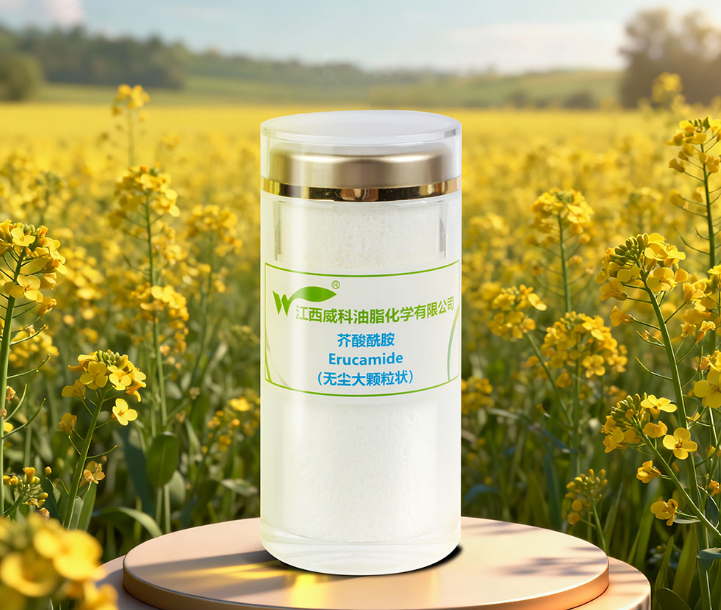
Erucamide holds the largest market share, accounting for approximately 38–45% of the segment. Its excellent thermal stability and controlled migration make it the preferred slip agent for polyolefin films such as BOPP, where long-lasting performance and clarity are essential. Oleamide, by contrast, is known for its rapid migration and is widely used in high-speed film extrusion processes where immediate slip is required.
Stearamide serves primarily as an internal lubricant and dispersant, improving melt flow and aiding in the uniform distribution of pigments and fillers. Behenamide, with its higher melting point and enhanced stability, is often used in engineering plastics and applications requiring greater thermal resistance.
These variations highlight the importance of selecting the right oleochemical additives based on processing conditions and end-use requirements. For manufacturers, understanding these differences is key to achieving optimal performance.
Key Growth Drivers in the Fatty Amide Market
Several major factors are fueling the growth of fatty acid amides across global industries. The rapid expansion of the plastic packaging sector is one of the most significant drivers. Flexible packaging applications rely heavily on polymer additives to control friction, improve handling, and prevent film layers from sticking together.
Sustainability is another critical influence. The shift toward bio-based and renewable materials is accelerating demand for environmentally friendly oleochemical additives. Regions such as Europe are leading this transition, with increasing adoption of plant-based feedstocks and circular economy practices.
The automotive industry also plays a major role, particularly with the rise of lightweight vehicles and electric mobility. Modern vehicles now incorporate over 150 kilograms of plastic components, significantly increasing the demand for processing aids like fatty acid amides. These additives function as lubricants and dispersants, ensuring efficient production and consistent material performance.
Challenges and Market Considerations
Despite strong growth, the fatty acid amide market faces several challenges. Raw material price volatility remains a concern, as fluctuations in feedstock costs can impact overall production economics. Additionally, performance limitations at extremely high processing temperatures, typically above 220°C, can restrict the use of certain amide types in advanced engineering applications.
Environmental considerations are also becoming increasingly important. Concerns related to bio-accumulation and regulatory compliance are prompting manufacturers to invest in cleaner, more sustainable formulations. As a result, continuous innovation is required to balance performance, cost, and environmental impact.
Future Trends: Innovation and Strategic Development
Looking ahead, the future of the fatty acid amide market will be shaped by several key trends. Sustainability will remain at the forefront, with increased focus on traceable, plant-based raw materials and low-carbon production processes.
Demand for high-purity additives is expected to rise, particularly in sensitive applications such as medical devices, electronics, and food packaging. These applications require strict compliance with global standards, including FDA and EU regulations, making purity and consistency critical factors.
Digitalization is also transforming the supply chain. Manufacturers are increasingly adopting digital platforms to manage sourcing, ensure traceability, and optimize inventory management. This shift is improving efficiency and reducing risk across the value chain.
Another important trend is the development of multifunctional additives. Combining properties such as slip agent, anti-block, and anti-static performance into a single compound can simplify formulations and enhance production efficiency, an increasingly attractive solution for modern manufacturers.
Partner with Topwellgoal for Advanced Oleochemical Solutions
As the demand for high-performance polymer additives continues to grow, selecting the right partner is essential. Topwellgoal is a trusted manufacturer of fatty acid amides and oleochemical additives, offering deep technical expertise, consistent product quality, and reliable global supply capabilities.
Manufacturers and distributors across Southeast Asia, China, and international markets are invited to collaborate with Topwellgoal to unlock new opportunities in polymer processing and product innovation. Whether your focus is on improving efficiency, enhancing material performance, or meeting sustainability goals, our team is ready to support your success.
Contact Topwellgoal today to explore how our advanced additive solutions can elevate your polymer applications and drive long-term value.