 Chinese
 Italian
 Spain
Spain French
 German
 Arabic
 Portugese

Types of Slip Agents in the Plastic Industry: Choosing the Right Additive for Optimal Performance
Efficient processing and consistent surface performance are critical requirements in today’s plastics industry. To meet these demands, manufacturers rely on specialized additives such as slip agents, which play a key role in reducing friction, preventing sticking, and improving the handling of plastic materials. Widely used in polyethylene (PE), polypropylene (PP), and other polymer systems, slip agents help ensure smooth production operations while enhancing the functionality and quality of finished plastic products.
Slip agents are widely used in polyethylene (PE), polypropylene (PP), and other polymer systems to ensure smooth processing, prevent blocking, and enhance the usability of plastic films, sheets, and molded parts. For manufacturers in packaging, automotive, and consumer goods industries, selecting the right type of slip agent is essential for balancing performance, efficiency, and product quality.
At Topwellgoal, we specialize in fatty acid amide slip agents and advanced oleochemical additives designed to optimize polymer performance. This article explores the main types of slip agents, how they work, and how to choose the right solution for your application.
What Are Slip Agents and Why Are They Important?
Slip agents are additives that reduce the coefficient of friction (COF) on the surface of plastic products. By lowering friction, they allow materials to slide easily over each other and across processing equipment.
This functionality is critical in plastic film production, where friction can lead to issues such as poor winding, processing delays, and surface defects. Slip agents also help prevent blocking, which occurs when layers of plastic film stick together.
In addition to improving manufacturing efficiency, slip agents enhance the performance of finished products by ensuring smooth handling, better surface feel, and improved functionality.
How Slip Agents Work: The Blooming Mechanism
Most commonly used slip agents operate through a mechanism known as migration or “blooming.”
During processing, slip agents are mixed into the molten polymer. As the material cools and solidifies, these additives, being partially incompatible with the polymer matrix, gradually migrate to the surface.
Once at the surface, they form a thin, microscopic lubricating layer that reduces friction and modifies surface energy. This layer allows plastic films and parts to slide more easily, improving both processing and end-use performance.
The speed and effectiveness of this migration depend on the type of slip agent used, its molecular structure, and the processing conditions.
Main Types of Slip Agents in the Plastic Industry
Slip agents can generally be classified into two major categories based on their chemical composition and mechanism of action: fatty acid amides and non-migratory additives such as waxes and silicones.
Fatty Acid Amide Slip Agents
Fatty acid amides are the most widely used slip agents in the plastics industry due to their efficiency, versatility, and cost-effectiveness. Derived from natural fatty acids, these oleochemical additives provide excellent slip performance even at low concentrations.
Oleamide: Fast Migration for Immediate Slip
Oleamide is one of the most commonly used slip agents, particularly in polyolefin films. It features a C18 molecular chain with a double bond, which allows it to migrate quickly to the surface.
This fast migration makes oleamide ideal for applications where immediate slip performance is required, such as thin films and high-speed packaging processes. However, its rapid blooming may lead to challenges such as uneven surface distribution or issues like roll telescoping in certain applications.
Erucamide: Controlled Migration for Long-Term Performance
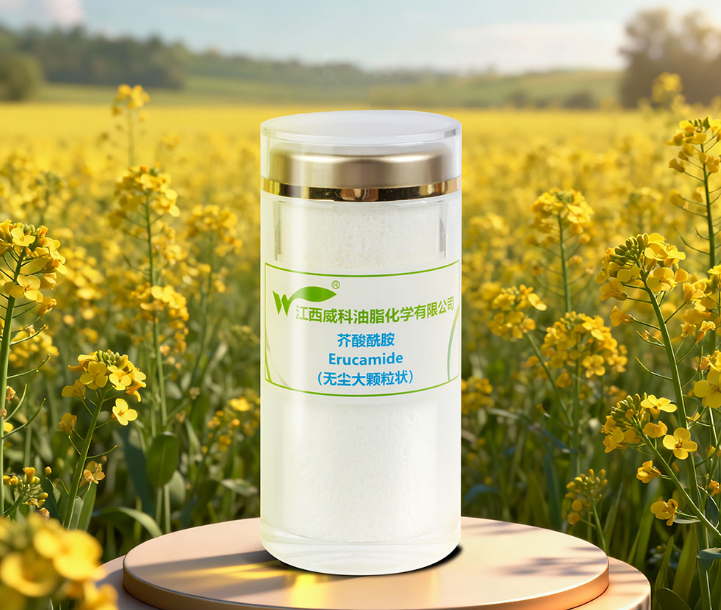
Erucamide, with a longer C22 chain, offers slower and more controlled migration compared to oleamide. This makes it suitable for applications requiring consistent and long-lasting slip performance.
Its higher thermal stability also makes it more suitable for demanding processing conditions. Erucamide is widely used in multi-layer films, thicker materials, and applications where surface consistency is critical.
Stearamide: High Thermal Stability
Stearamide is a saturated fatty acid amide that provides excellent thermal stability. While it is less effective as a slip agent compared to oleamide or erucamide, it is highly valued in applications involving high processing temperatures.
It is often used as a secondary slip agent or internal lubricant, contributing to improved processing stability and surface properties in engineering plastics and high-temperature systems.
Non-Migratory Slip Agents: Waxes, Silicones, and PTFE
In addition to fatty acid amides, several non-migratory slip agents are used in specialized applications where blooming is not desirable.
Waxes
Polyethylene and paraffin waxes provide immediate slip by forming a lubricating layer on the surface. However, they must be carefully selected for compatibility with the polymer to avoid issues such as haze or phase separation.
Silicone Additives
Silicone-based slip agents, typically derived from polysiloxanes, offer excellent lubricity and thermal stability. Unlike amides, they migrate more slowly and provide long-lasting surface modification.
Silicones are commonly used in applications requiring improved surface smoothness, scratch resistance, and high-temperature performance. However, they may affect printability and adhesion if not properly formulated.
PTFE (Polytetrafluoroethylene)
PTFE is a non-migratory additive that provides permanent slip and exceptional abrasion resistance. It is often used in high-performance engineering plastics where durability and long-term performance are critical.
Because PTFE does not rely on migration, it is suitable for applications where surface stability and consistent performance are required over time.
How to Choose the Right Slip Agent
Selecting the appropriate slip agent depends on several factors, including polymer type, processing conditions, and end-use requirements.
Migration rate is a key consideration. Fast-blooming agents such as oleamide are ideal for applications requiring immediate slip, while slower-migrating additives like erucamide provide more controlled and durable performance.
Thermal stability is another important factor. High-temperature processes may require more stable additives such as stearamide or specialized formulations to prevent degradation.
Regulatory compliance is critical for applications such as food packaging and medical products. Slip agents used in these applications must meet strict standards such as FDA or EU regulations.
In some cases, non-migratory systems may be preferred, especially in multi-layer films or applications requiring surface treatment such as printing or sealing.
The Role of Slip Agents in Modern Plastic Applications
Slip agents are essential for a wide range of applications across the plastics industry. In flexible packaging, they ensure smooth film handling and prevent blocking. In automotive components, they improve surface durability and reduce friction. In consumer goods and industrial materials, they enhance both processing efficiency and product performance.
As materials become more advanced and application requirements more demanding, the importance of selecting the right slip agent continues to grow.
Partner with Topwellgoal for Advanced Slip Agent Solutions
Topwellgoal is a leading manufacturer of fatty acid amide slip agents, offering a comprehensive range of products including oleamide, erucamide, stearamide, and customized formulations for diverse plastic applications.
With extensive expertise in oleochemical additives, we provide solutions that enhance processing efficiency, improve surface performance, and ensure consistent product quality.
Whether you are producing packaging films, engineering plastics, or high-performance materials, Topwellgoal can support your needs with reliable products and technical expertise.
Contact Topwellgoal today to explore our advanced slip agent solutions and discover how we can help optimize your plastic production processes and improve your product performance.